VLM-Guided Segment Annotation · Satellite Imagery

SatEdit: Mask-Conditioned Image Editing via VLM-Guided Segment Annotation

A data-efficient framework that turns unlabeled overhead imagery into paired editing supervision — editing the region you select while preserving the surrounding scene.

Independent Researchers
Overview of SatEdit
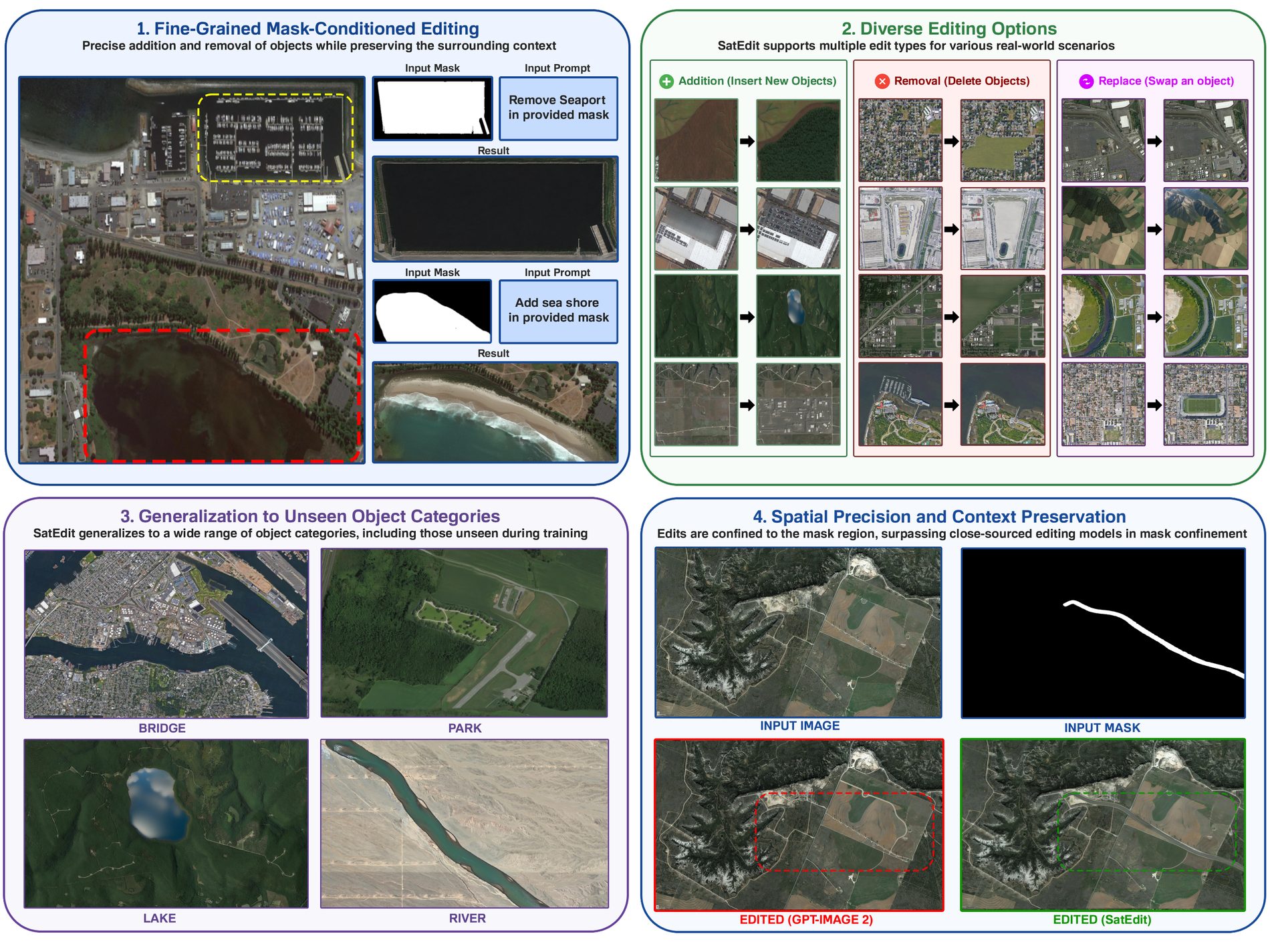
Overview of SatEdit. Given a satellite image, a binary mask, and a text prompt, SatEdit edits the selected region while preserving the surrounding scene. The model is trained on object addition and removal, and also transfers to replacement prompts and categories outside the training set.

Abstract

Data-efficient, spatially controllable satellite editing

Satellite image editing requires spatially precise object-level control, but supervised editing datasets for overhead imagery are costly to build because object masks, semantic labels, and paired edits are rarely available at scale. We introduce SatEdit, a mask-conditioned satellite image editing framework that constructs training supervision from unlabeled imagery. SatEdit proposes object masks with a segmentation foundation model, assigns semantic labels to sampled segments with a Vision-Language Model, and applies lightweight human verification before generating paired addition and removal examples through mask-guided inpainting. We fine-tune a high-resolution image editing backbone with LoRA on a SODA-A-derived dataset containing 1,014 images and 852 verified object annotations across 91 classes. In controlled comparisons with open-source and proprietary image editing models, SatEdit achieves the highest aggregate masked-region semantic alignment, with a CLIP score of 0.6322 and CLIP delta of 0.0726, while preserving the surrounding scene qualitatively.
1,014
Satellite images
852
Verified annotations
91
Semantic classes
0.6322
Aggregate CLIP ↑
0.0726
CLIP Δ ↑

Method

From unlabeled imagery to mask-conditioned editing pairs

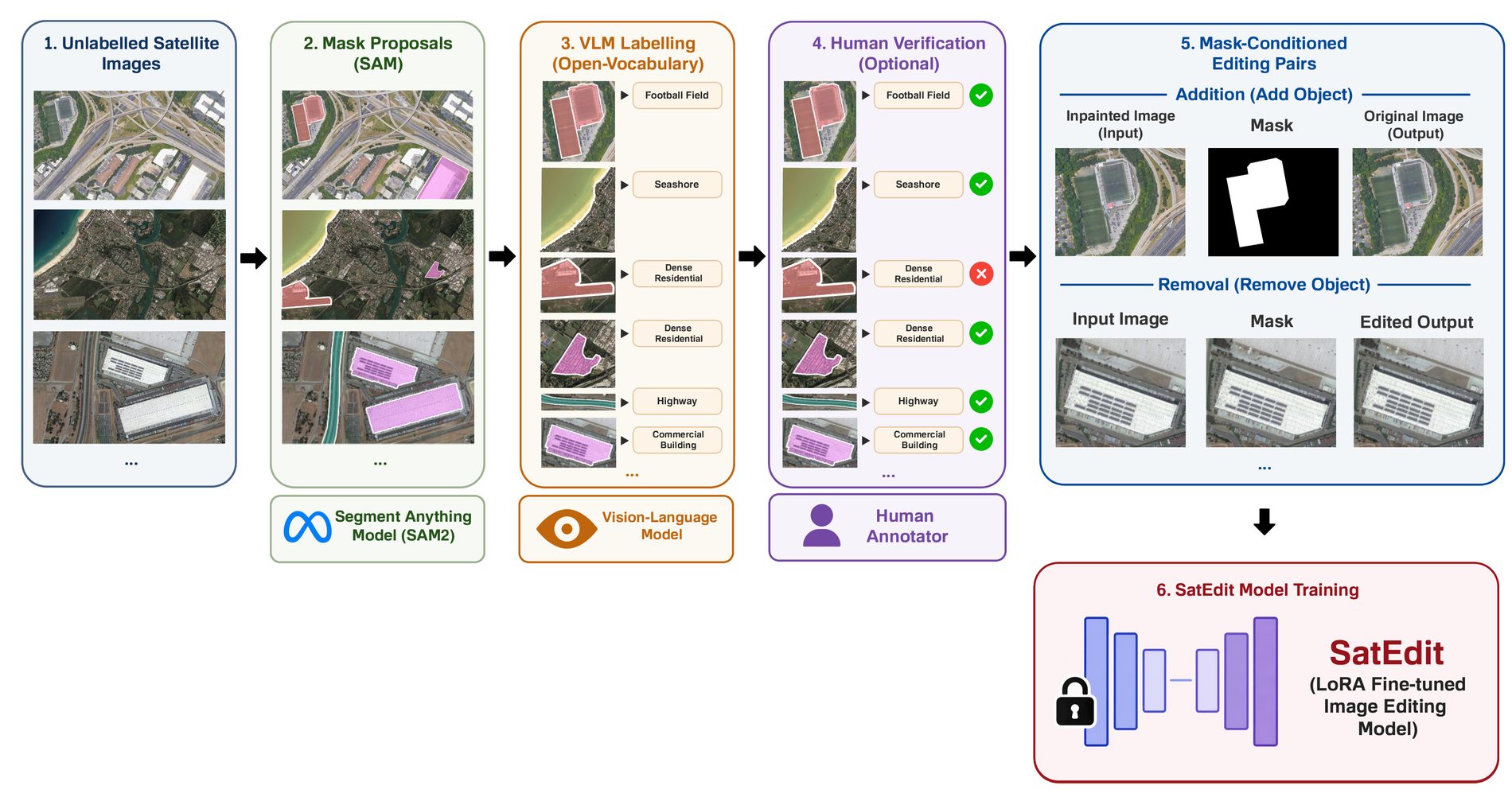
Rather than manually authoring before/after pairs, SatEdit decomposes supervision into spatial support, object semantics, label verification, and edited-image synthesis.

1

Mask proposal

SAM2 generates dense, class-agnostic object masks over each satellite scene; area-based filtering and subsampling keep the informative segments.

2

VLM labeling

Qwen3-VL labels each mask-aware crop from a fixed satellite-object vocabulary — constrained classification that reduces hallucination.

3

Human verification

A single-pass check turns annotation into validation: annotators accept or correct the predicted label, not create it from scratch.

4

Pair synthesis

Mask-guided inpainting (LaMA) converts verified segments into paired addition and removal examples with source image, mask, and instruction.

SatEdit data-generation and fine-tuning pipeline
SatEdit data-generation and fine-tuning pipeline. Unlabeled satellite imagery is converted into mask-conditioned editing supervision, which is then used to fine-tune the SatEdit image-editing model with LoRA.
Semantic composition of the SatEdit annotations
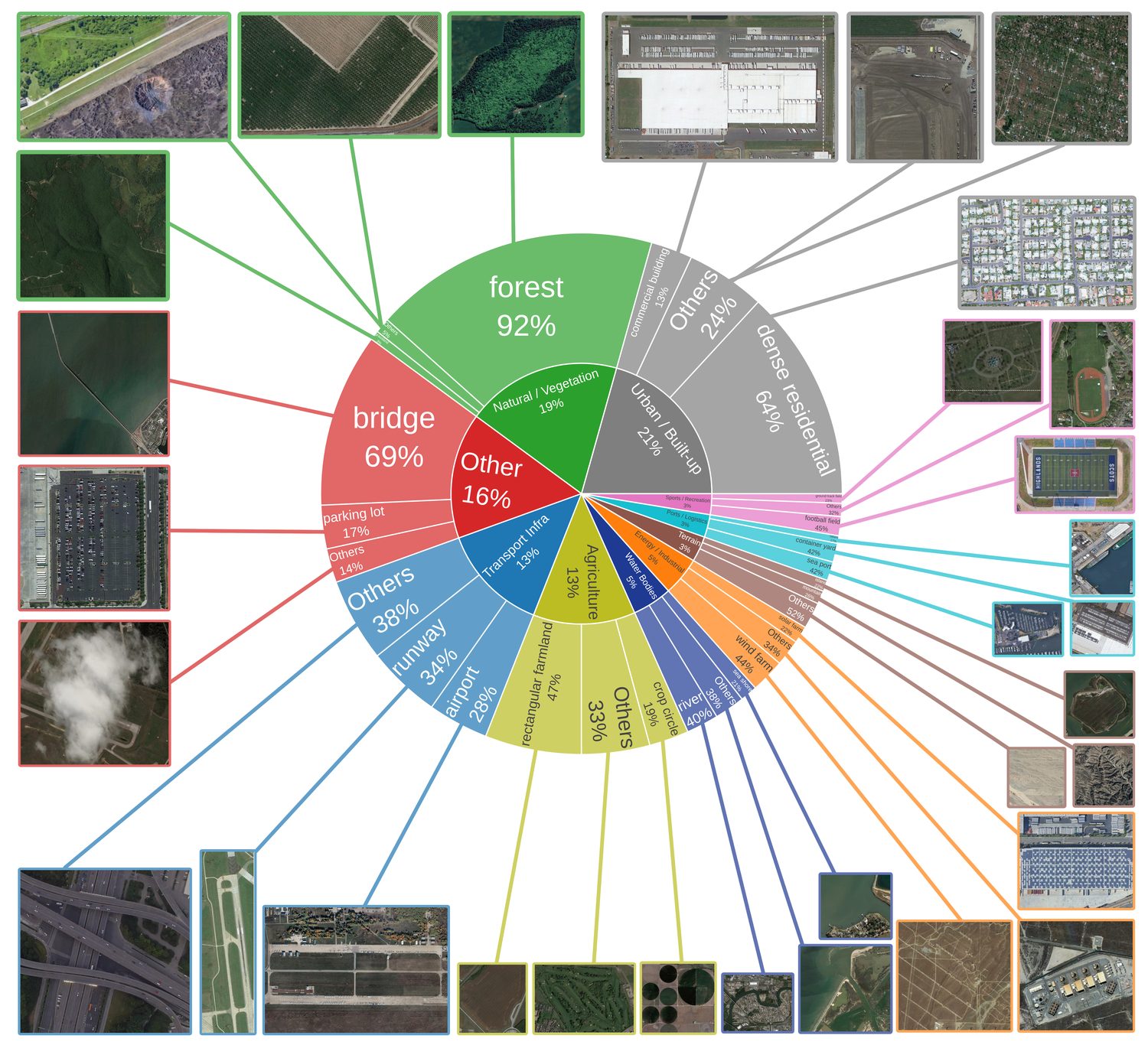
Semantic composition of the SODA-A-derived annotations. The 91 segment labels grouped into broad satellite-scene categories. The distribution is long-tailed, with common classes such as forest, dense residential, bridges, and farmland providing repeated supervision.

Results

Quantitative benchmark

SatEdit obtains the highest CLIP and CLIP Δ across addition, removal, and the aggregate — strongest prompt-aligned editing inside the mask. Nano Banana 2 remains the most conservative editor, changing the background least.

↑ higher is better · ↓ lower is better · gold = best in column. CLIP measures masked-region semantic alignment; Leakage measures change outside the mask; PSNR-out / SSIM measure background preservation.


Paper figures

Full qualitative grids

Qualitative comparison grid
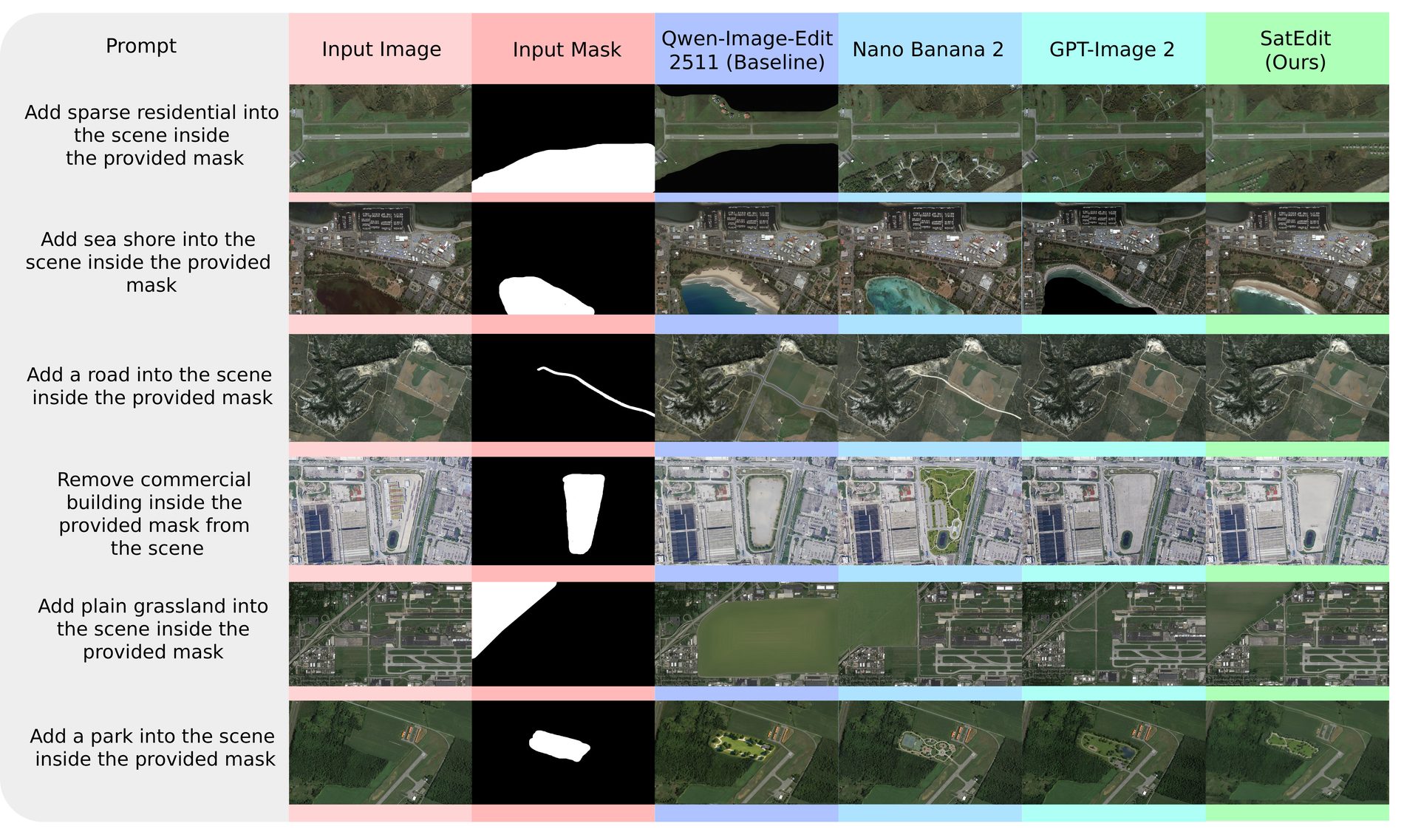
Qualitative comparison. Columns show the editing prompt, input image, input mask, baseline outputs from Qwen-Image-Edit-2511, Nano Banana 2, and GPT Image 2, and the SatEdit output.
Qualitative effect of LoRA scale
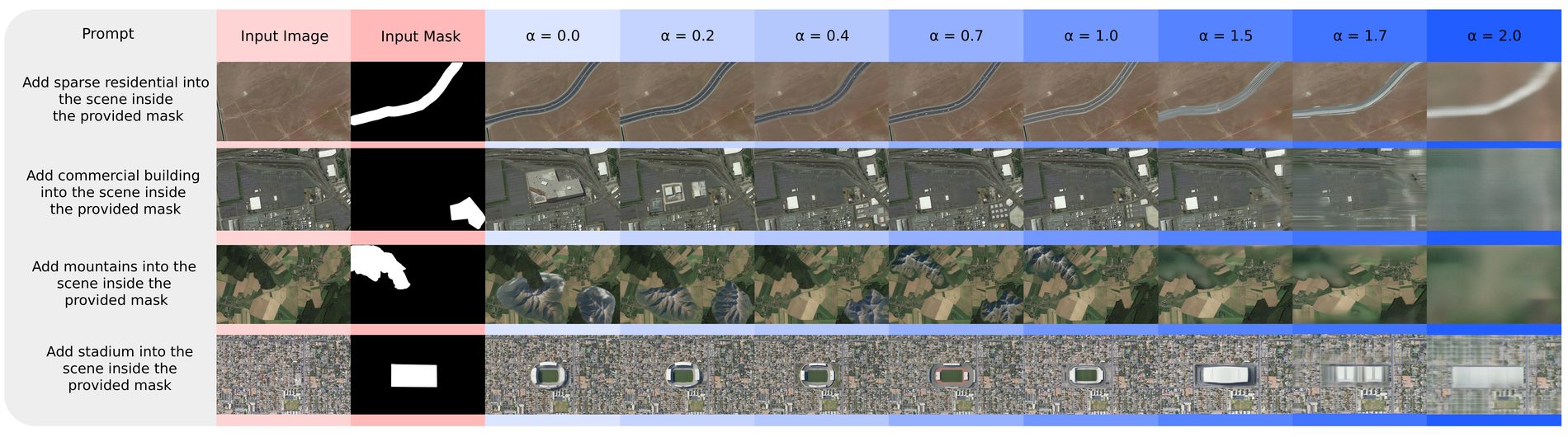
Qualitative effect of LoRA scale. Each row fixes the prompt, image, mask, and seed while varying only the SatEdit adapter scale α. Low-to-moderate scales preserve satellite context and localize edits; high scales blur the scene and wash out object boundaries.

Citation

BibTeX

@article{talha2026satedit,
  title   = {SatEdit: Mask-Conditioned Image Editing via VLM-Guided Segment Annotation},
  author  = {Talha, Muhammad and Amer, Muhammad Ahmed},
  year    = {2026}
}